
From Intuition to Insights: Why Data Analytics Is Non-Negotiable for the Modern Enterprise
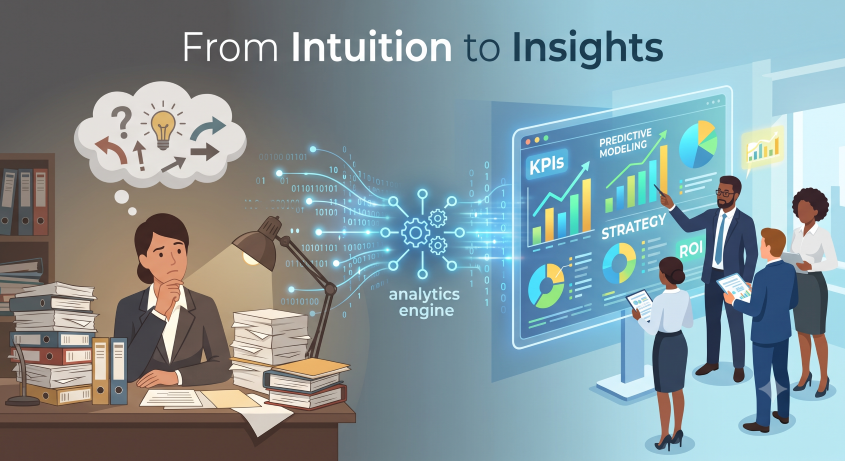
In today’s corporate landscape, relying solely on intuition is a high-stakes gamble. While gut instinct and industry experience built many of yesterday’s business empires, modern corporations operate in environments far too fast, complex, and volatile for educated guesses.
Data analytics has shifted from a back-office IT function to the central nervous system of corporate strategy. It transforms raw, chaotic information into operational clarity—turning routine business decisions into repeatable, data-backed wins.
Here is why data analytics is no longer just a luxury for tech giants, but a core necessity for any business looking to survive and scale.
Smarter, Faster Decision-Making
Every corporate decision carries risk, whether you are launching a product, entering a new market, or reallocating a budget. Data analytics strips away the ambiguity.
By evaluating historical trends, market fluctuations, and real-time operational performance, executives can test hypotheses before committing capital. Instead of asking “What do we think will happen?”, leaders can look at concrete probability models to ask “What does the data show will happen?”
This shifts corporate strategy from reactive damage control to proactive planning, cutting the time spent endlessly debating opinions in boardroom meetings.
Unlocking Hyper-Personalized Customer Experiences
Today’s consumers demand seamless, personalized experiences. They expect brands to understand their preferences, anticipate their needs, and solve their friction points before they even bring them up.
Data analytics allows organizations to map customer journeys with surgical precision. By analyzing purchasing patterns, digital interactions, and customer feedback, businesses can:
- Segment audiences into highly specific behavioral profiles.
- Deliver targeted marketing campaigns with higher ROI.
- Tailor customer support interactions to reduce churn and build long-term brand loyalty.
When you understand your customers at a granular level, customer retention turns from an uphill battle into a natural outcome.
Operational Efficiency and Cost Optimization
Efficiency isn’t just about cutting expenses; it’s about getting the absolute maximum value out of your resources. Data analytics shines a spotlight on internal operational bottlenecks that would otherwise go unnoticed.
For example, in supply chain management, predictive analytics can forecast demand spikes, prevent inventory overstocking, and optimize delivery routes to save millions in logistics. In human resources, workforce analytics can identify employee burnout risk and streamline recruitment pipelines.
By pinpointing exactly where money, time, and talent are being underutilized, organizations can lean down operational costs without sacrificing quality or morale.
Gaining a Sustainable Competitive Advantage
In a crowded market, products and services are easily copied. Operational intelligence, however, is much harder to replicate.
Companies that master data analytics don’t just keep up with market trends—they spot them before their competitors do. Advanced predictive models allow organizations to detect subtle shifts in consumer behavior, macroeconomic trends, and competitive threats early enough to pivot before the rest of the market reacts.
Being first to adapt gives brands a distinct, hard-to-shake market advantage.
Bridging the Gap: Moving from Data-Rich to Insight-Driven
Having access to data is not the same as using it effectively. Many corporations fall into the trap of hoarding vast amounts of data in isolated silos without a clear framework for analyzing it.
To turn data into a true corporate asset, organizations must focus on three core foundational elements:
- Data Hygiene and Governance: Ensure the information being collected is accurate, clean, secure, and accessible across teams.
- Cultivating Data Literacy: Train employees across all departments—not just data scientists—to interpret and ask the right questions of data.
- Action-Oriented Metrics: Focus tracking efforts on actionable key performance indicators (KPIs) that directly tie into strategic business goals, rather than vanity metrics.
Data analytics is much more than software, dashboards, or charts—it is a cultural commitment to truth over opinion. The corporations that thrive over the coming decade will be those that integrate analytical thinking into every operational layer, using clear insights to innovate faster, serve customers better, and navigate uncertainty with confidence.





 🆄🅽🅳🅴🆁
🆄🅽🅳🅴🆁